Sometimes an artistic vision arrives so clearly that you can already see the finished creation before you’ve made it. And sometimes, no matter how hard you try, you cannot bring it into form.
That happened to me recently.
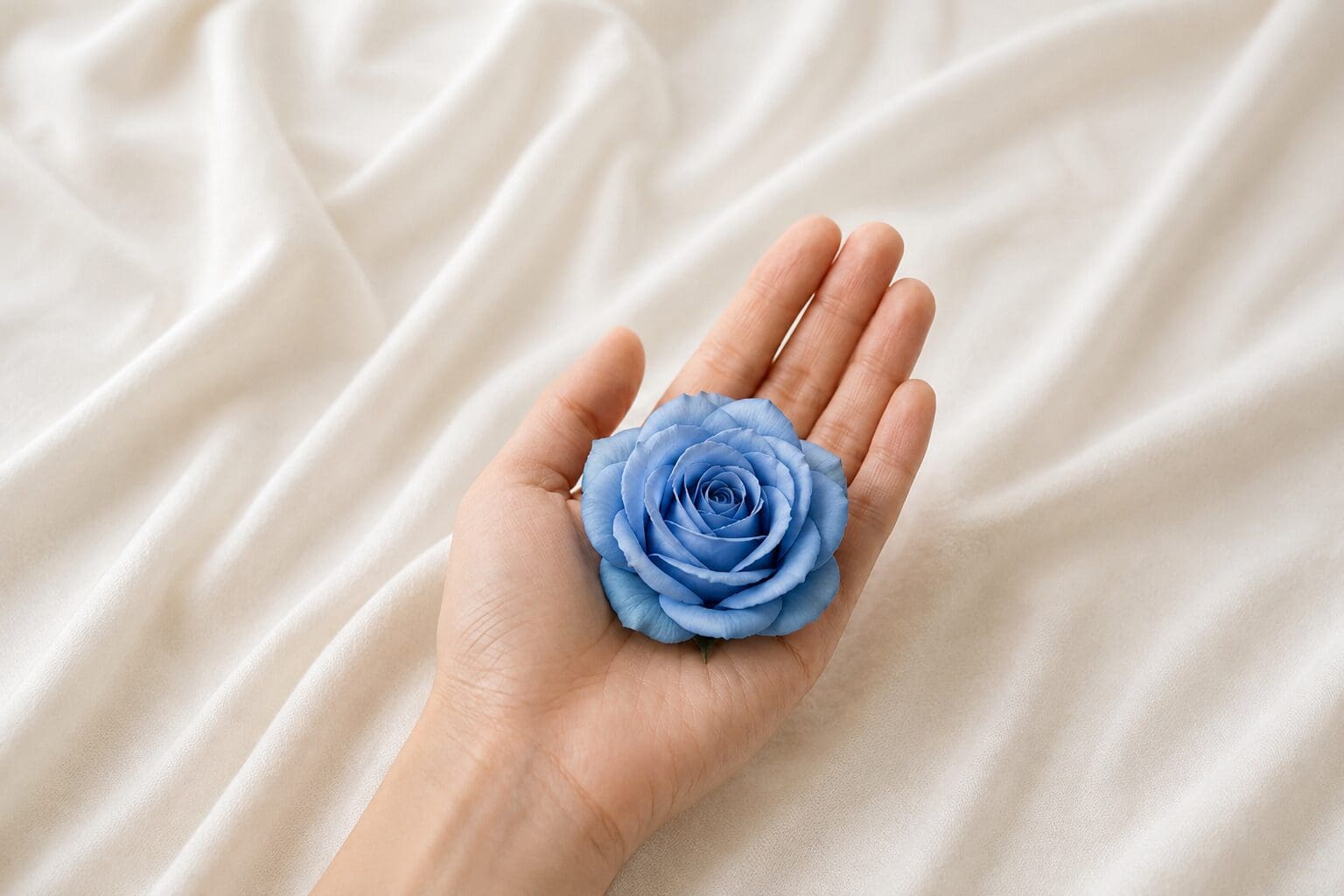
The Blue Rose
The vision originally came from a dream.
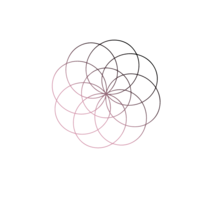
There was a hand holding a blue rose. My original Light Language artwork appeared above it, transformed into luminous blue light. There was movement and rotation before everything dissolved and returned to the blue rose.
I could see it.
I’d just started experimenting with AI video at that time and I thought:
I can make this.
So I tried.
The first challenge was preserving my original artwork.
One AI model created beautiful results, but kept changing the Light Language itself. For me, that was an immediate no. The artwork isn’t decoration that can simply be reinterpreted. Its integrity matters to me.
So I changed models.
The next model could preserve the artwork much better, but couldn’t create the luminous blue-light transformation I had envisioned.
I tried different prompts, different instructions, and different approaches. Eventually, I thought perhaps I was simply asking for too much from AI.
So I simplified the vision.
When Simplifying Doesn’t Solve It
First, I removed the hand. Now there were fewer elements:
Just the blue rose and the Light Language.
Surely that would be easier. And somehow, it wasn’t.
One AI generation would get the Light Language right but the rose wrong. Another would create a beautiful rose but distort the Light Language.
So I thought, let’s simplify even further.
This time, I removed the Light Language too.
Now all AI had to do was create the transformation around the blue rose. And still, when I looked at the final result, I felt disappointed.
Not because it was necessarily horrible.
It simply wasn’t my vision anymore.
Somewhere along the way, I had gone from trying to bring my dream into form to repeatedly negotiating with what the technology was capable of giving me.
And after hours of work and thousands of AI credits, I stopped.
I abandoned the project.
Or at least, I thought I did.
Stop While It’s Fun
I’ve spent a lot of time—and a lot of credits—on AI creations before. But this experience felt different.
Usually, even when something takes many attempts, I can feel myself getting closer. Maybe the first generation gets 50% of the vision. The next gets 70%.
That progress creates the very seductive thought:
One more try.
And sometimes one more try really is the one. But this time around, it was the total opposite.
I wasn’t getting any closer.
I was regenerating, changing prompts, simplifying, changing models, spending more credits—and becoming more frustrated with every attempt.
Somewhere along the way, it stopped being fun.
There is a difference between staying with a vision because something in you knows there is still more to explore, and insisting that something must work simply because you’ve already invested so much into it.
One can feel like devotion. The other can slowly become force.
I think part of being an artist is learning to recognize the difference.
When the Artist Cannot Make What She Sees
I don’t think this experience belongs only to AI artists.
A writer can have an idea and spend an hour unable to put it on the page.
A painter can see an image clearly in her mind and discover that her hands cannot reproduce the exact same image.
A musician can hear something that doesn’t quite translate into a song.
Sometimes a creation arrives in five minutes. Sometimes you work for five hours and somehow feel further away than when you began.
There is a particular kind of frustration in that.
Because when the vision is clear, it feels as though the creation already exists somewhere. You can see it. You know what it wants to be. And yet you cannot make the physical thing match what you know.
Eventually, there may come a point when simplifying the vision is no longer simplification. You’re removing pieces of it one by one just to make something work.
And perhaps that’s when the question changes.
Not:
How do I make this work?
But:
Is this still the thing I wanted to create?
For me, eventually, the answer was no.
Abandoning the Vision Is Not Failure
“Abandon” is a strong word.
It can sound like giving up. Like you aren’t committed enough, or you’re simply not good enough.
But abandoning a vision says absolutely nothing about your worth as an artist.
Sometimes there is simply a gap between what you can see and what is available to you right now—whether it’s the resources, the medium, or simply a matter of divine timing.
And abandoning a vision today doesn’t necessarily mean abandoning it forever.
Maybe another medium can hold it better. Maybe technology catches up. Maybe you return to it later with something you don’t have today.
Or maybe what you thought was the finished vision was only a seed, and you were trying to make it become fruit before its time.
Sometimes all we know is:
Not like this. Not right now.
And that can be enough.
Maybe I Wasn’t Abandoning the Vision After All
After I had finally decided to stop, I sent two of the versions I had made to a close friend.
I wanted an objective opinion from someone who hadn’t spent hours staring at every generation and comparing it against the vision inside my head.
She loved both.
More importantly, the tiny details I had been scrutinizing weren’t even what she noticed.
She experienced the videos as they were. She noticed the mystical background. She had a preference between the two versions. She even saw her own meaning in the way the artwork unfolded.
I couldn’t see any of that anymore because I was too busy comparing the creation in front of me with the invisible reference image inside me.
And suddenly I realized:
Maybe I didn’t need to abandon the Blue Rose.
Maybe I needed to abandon my insistence that it become exactly what I had imagined.
There is a strange tension in being the creator.
We know every detail that didn’t work. We know what was supposed to happen. We know the 2% that isn’t right.
The person receiving the creation knows none of that. They only know what is in front of them.
That doesn’t mean as an artist, you should ignore your own discernment or compromise your vision.
But there is a difference between discernment and putting your creation under a microscope until the 2% you dislike becomes larger than the 98% that is already beautiful.
I couldn’t see that while I was still trying to fix it.
I needed to stop first.
And perhaps that was the real abandonment.
Not the vision.
The insistence.
Once I put that down, I could finally see what I had actually created.
If you’d love to enter the vision I created, you can watch the Blue Rose emerge here.
LEAVE A COMMENT
Comments