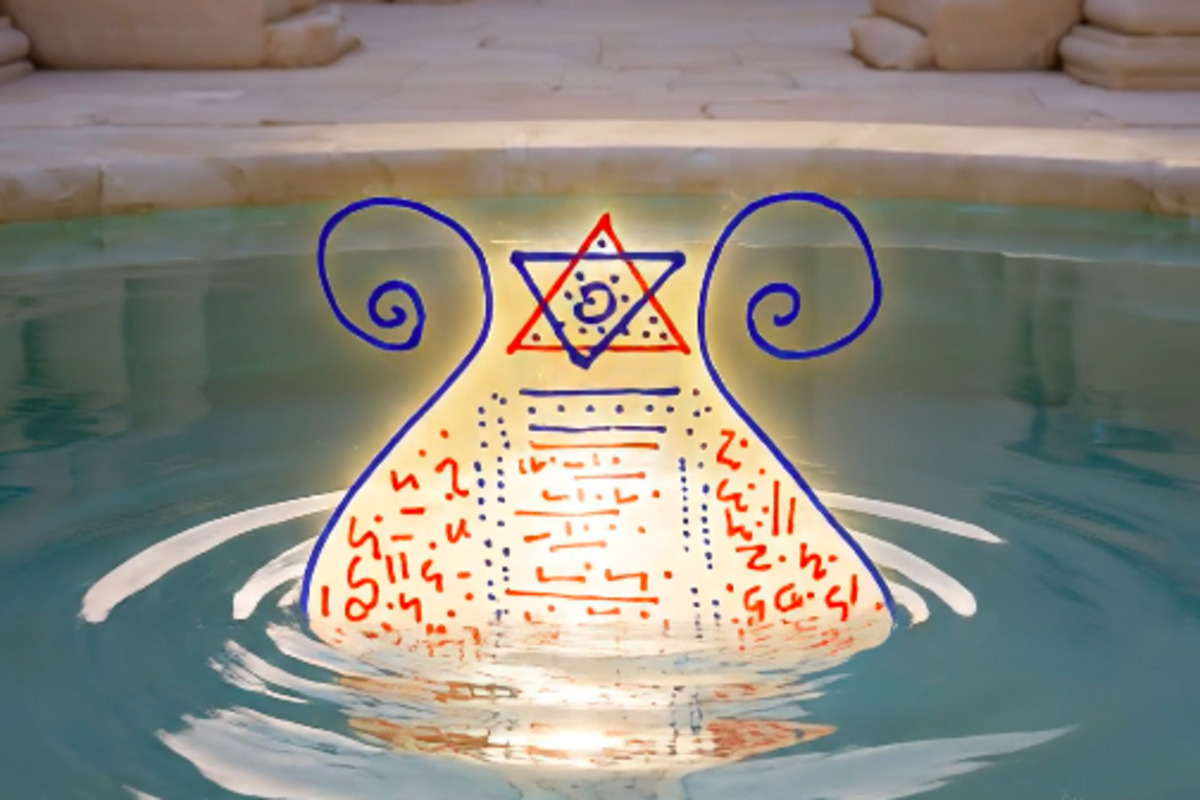
You can already see how your artwork wants to move.
The codes rising from the page. The light moving through the symbols. The water beginning to flow. The artwork becoming fully alive.
Then you give it to AI—and it changes the symbols, rearranges the composition, invents details that were never there, or creates something visually beautiful that no longer feels like yours.
This is one of the strangest parts of learning to animate sacred artwork with AI.
Your vision may be clear within you, but AI does not automatically understand which parts of the artwork are allowed to move, which parts must remain untouched, or why one small alteration can change the feeling of the entire piece.
The problem is not that your vision is too difficult.
You simply need to translate it into language AI can understand—while remaining clear about what must never be changed.
Sacred Artwork Is More Than a Visual Asset
When you create Light Language or sacred artwork, you are not simply arranging attractive shapes on a page.
The symbols may have arrived intuitively. The composition may hold a particular energy. A line that looks insignificant to someone else may carry an important meaning within the whole piece.
This is why allowing AI to animate sacred artwork can feel surprisingly vulnerable, especially when it raises deeper questions of authenticity.
You are placing something created through your hands, intuition, and spiritual connection into a technology that does not inherently understand its significance.
AI sees an image.
You see the transmission, intention, and experience held within it.
If the prompt only says, “Make this artwork come alive,” AI has enormous freedom to decide what alive means. It may redraw the symbols, add dramatic effects, replace parts of the composition, or transform the artwork into an entirely different visual world.
The result might be impressive.
But impressive is not always the same as true.
When a Beautiful Animation Still Feels Wrong
During my own experimentation with AI animation, some results “failed” in obvious and occasionally hilarious ways. Elements behaved strangely. Movements appeared that I had never requested. In one animation, the woman simply teleported herself.
Other results were more difficult to evaluate because they were technically beautiful.
The colours were luminous. The movement was cinematic. The animation looked polished.
And yet, something had been lost.
The AI had produced a beautiful video, but it was no longer revealing the original artwork. It had begun replacing it with its own interpretation.
Across these experiments, I began to see that the quality of the result depended less on finding one “perfect prompt” and more on becoming clear about the movement I was actually trying to create.
This taught me an important distinction:
The goal is not to make the artwork more impressive. The goal is to reveal what is already moving within it.
Your artwork is already alive. Animation simply makes the movement you sense visible to someone else.
Begin With the Vision, Not the Prompt
One of the easiest ways to become frustrated with AI is to begin by asking:
“What should I write in the prompt?”
A more useful question is:
“What do I actually want to happen?”
Before choosing the perfect words, become clear about the movement you see, the experience you want to create, and what must remain untouched.
After experimenting with thousands of AI credits, I developed a simple five-part framework that helps me define an animation before writing the prompt—because when the vision is clear, the language becomes much easier.
Protect the Artwork Explicitly
If you want the original artwork preserved, do not assume AI will understand that automatically.
You need to define what AI is allowed to animate—and what it must not redraw, reinterpret, rearrange, or replace.
The clearer you are about what must remain unchanged, the more creative freedom you can give AI within the movement itself.
This is not about controlling every pixel. It is about protecting the artistic decisions that make the work yours while still leaving space for creative surprise.
Experimentation Is Part of the Art
Even with a thoughtful prompt, not every generation will match the vision immediately.
Each result can show you where your language was unclear, where AI interpreted something differently, or where your own vision still needed refinement.
Perhaps the movement was too complicated, the transformation happened too quickly, or an unexpected result revealed a direction you had not considered.
The aim is not to eliminate experimentation. It is to create with greater clarity, learn from each generation, and use your AI credits more intentionally.
You Remain the Artist
AI can generate movement—but you are the one who gives that movement meaning.
You decide what matters within the artwork. You recognise when something visually impressive has lost the original soul. You know when the animation feels complete, even if it is not technically perfect.
Your discernment—not the technology—is what holds the integrity of the work.
When you remain the creative authority, AI stops leading the process.
It begins following your direction.
Bring Your Sacred Artwork to Life
I created The Sacred Art of AI Animation from this real process of testing prompts, watching AI misinterpret sacred artwork, refining the language, and discovering what helped each animation move closer to the original vision.
Inside the visual field guide, I share three real animations, the exact prompts I used, a simple five-part framework, guidance for preserving your original artwork, and a practical prompt-writing checklist.
It is designed for Light Language artists, spiritual creators, and visionaries who want to explore AI animation without losing the symbols, composition, or soul of what they created.
LEAVE A COMMENT
Comments