I think I’ve officially come out of the AI closet. Which is hilarious, because a few months ago, I probably would have been horrified by that sentence.
My relationship with AI started innocently enough.
A thumbnail here. A Pinterest graphic there. Then Instagram. Then more images. Eventually video. And somewhere along the way, I became increasingly aware of one question:
Does this look too AI?
If an image looked too fantastical, I would generate another one. If something didn’t look sufficiently realistic, I didn’t want to use it.
Then social media platforms started adding AI information labels, and that brought up another layer.
What if people know it’s AI?
Not because I was pretending I didn’t use it. I openly talked about AI and even wrote an entire article about how I approach it while keeping my intuition at the center of my work.
But there was still a part of me that preferred AI to remain somewhat invisible.
And then, gradually, something changed.
I Stopped Caring If People Knew
At some point, I realized:
Why am I worried about an AI label when I actually use AI? Wouldn’t it be stranger to use AI while desperately trying to make sure nobody could tell?
So I stopped caring.
If a post gets an AI information label, fine.
There. I said it.
Apparently this is me coming out of the AI closet.
And once I stopped spending so much energy worrying about whether people could tell, I started having a lot more fun.
I Went to the Neighbor’s House and Made a Mess
There is a particular kind of responsibility I feel toward my Lemurian work. I don’t allow AI to tell me what Lemuria is. I don’t ask it to search the internet and construct my spiritual teachings for me.
That work comes through my own experiences, memories, intuition, channeling, reflection, and relationship with what I understand Lemuria to be.
I consider myself a steward of that work. There is a temple around it. And I love that temple.
But lately, I’ve discovered how liberating it can be to occasionally leave the temple and go play at the neighbor’s house.
Apparently the neighbor’s house is AI. And apparently I don’t care if I make a mess there.
When I began creating Sacred Art of AI Animation, I gave myself much more room to experiment.
I could bring the ideas and let AI help me structure them. I could dictate what I wanted to say and let AI help me shape the draft. I could try strange visual concepts, dislike them, laugh about them, change direction, and try again.
The content still came from my experience. The creative direction still came from me.
But I wasn’t holding every sentence as though it belonged on a stone tablet inside a Lemurian temple.
There was space to play.
And I hadn’t realized how much I needed that.
Perhaps that’s also why I’ve found myself marketing this little AI guide more easily than some of my much larger spiritual offerings. There are so many angles, visuals, and experiments to play with.
Not everything I create needs to carry the entire weight of who I am.
And apparently, that freedom was beginning to show up in the work itself.
And Then There Was the Glowing Woman
This might be the moment I realized just how much had changed. I was creating an AI video for Under the Lemurian Moon.The old me probably would have regenerated the entire thing.
Because within the first two seconds, there she was:
A woman lying beneath the Lemurian moonlight, glowing so intensely she looked like she’d been electrocuted by it.
Definitely AI.
Definitely not the soft, subtle Lemurian aesthetic I usually gravitate toward.
And somehow, I decided to keep her.
Apparently Director Elies had entered a new era.
The reveal that came afterward was beautiful. I loved the concept. I loved the direction.
It simply happened to be more fantastical than most of the videos I create.
And I suddenly thought:
So what?
A filmmaker can create a realistic movie and then make a fantasy movie. An artist can work in watercolor and then make a cartoon. A director can create something subtle today and completely surreal tomorrow.
Why had I decided that everything I created with AI needed to successfully impersonate reality?
Maybe the glowing woman wasn’t the problem. Maybe my need to prove that I wasn’t making “AI-looking AI” was.
So she stayed.
Maybe people will see a glowing woman and immediately scroll away. Maybe they’ll stop because they want to know why on earth this woman is glowing.
I’ve been creating long enough to know that I don’t actually know.
And there’s freedom in that too.
But There Is One Thing I Still Won’t Compromise
Becoming more relaxed about AI hasn’t made me less discerning.
When I animate my original sacred artwork, preserving that artwork is non-negotiable.
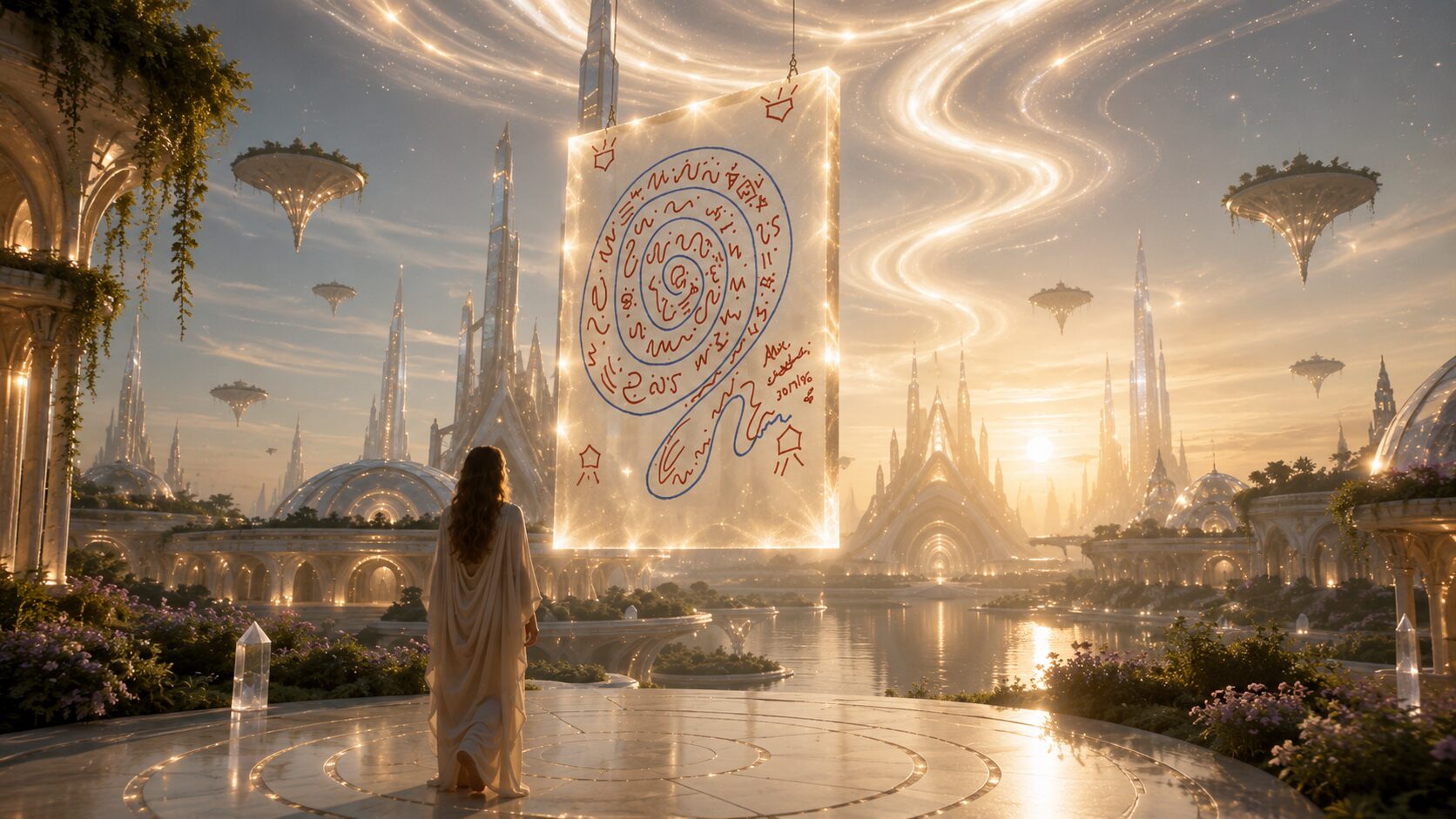
I learned this the expensive way after repeatedly trying to animate one of my pieces and watching an AI video model turn parts of my original artwork into random scribbles.
No.
Absolutely not.
I would rather abandon the generation than use a beautiful video that changes the artwork itself.
And that’s where I discovered an important distinction:
I don’t need AI to look less like AI. I need it to respect what is mine.
The environment can become fantastical.
The moon can glow.
Apparently the woman can glow too.
But my artwork remains my artwork.
Using AI doesn’t mean giving my creative power away.
Sacred Art of AI Animation
Sacred Art of AI Animation grew directly out of this season of experimentation.
It’s for artists who already have sacred artwork of their own and want to explore turning that artwork into a cinematic AI video without giving their creative power away to AI.
I share the process I’ve been using, the lessons I’ve learned through plenty of successful and unsuccessful generations, and one principle that remains at the center of everything I create:
The AI is the tool. You are still the artist.
If you’ve been curious about bringing your own sacred artwork into motion, you can explore Sacred Art of AI Animation here.
LEAVE A COMMENT
Comments