An Artist Journal reflection on creativity, abundance, and why I don’t believe the future has to be either/or.
Someone recently left a comment on one of my AI videos suggesting that perhaps I should stop using AI because it is going to replace artists, especially since I love art so much.
My response was simple:
I believe AI and artists can coexist.
I don’t think everyone needs to embrace AI, and I don’t think every artist needs to use it. That doesn’t mean there aren’t valid conversations to be had about how AI is being used.
But something about the idea that loving art means I shouldn’t use AI stayed with me. Because underneath it, I hear a much older story: the story of either/or. To be exact, I hear scarcity.
The Scarcity of Either/Or
Scarcity tells us that if one thing exists, there is less room for another. If AI becomes capable of creating, there must be less room for artists. If AI can do something a human once did, the human must inevitably lose.
Abundance asks a different question:
Why can’t there be room for both?
AI and artists. The handmade and the digital. Tradition and evolution.
Scarcity looks at something new and immediately calculates what might be lost. Abundance can acknowledge what might change while also asking what this might open.
Because even if AI changes certain forms of creative work, perhaps that isn’t the end of the story. Perhaps it also asks artists to explore ways of creating that we haven’t explored before. Perhaps it expands us beyond what we already know and invites us into forms of expression we haven’t imagined yet.
There is room for development, expansion and reinvention. The equation doesn’t have to end at replacement.
AI Has Actually Made Me Create More Art
This is the part I find particularly interesting, because if AI were replacing the artist in me, I would expect myself to be creating less. The opposite has happened.
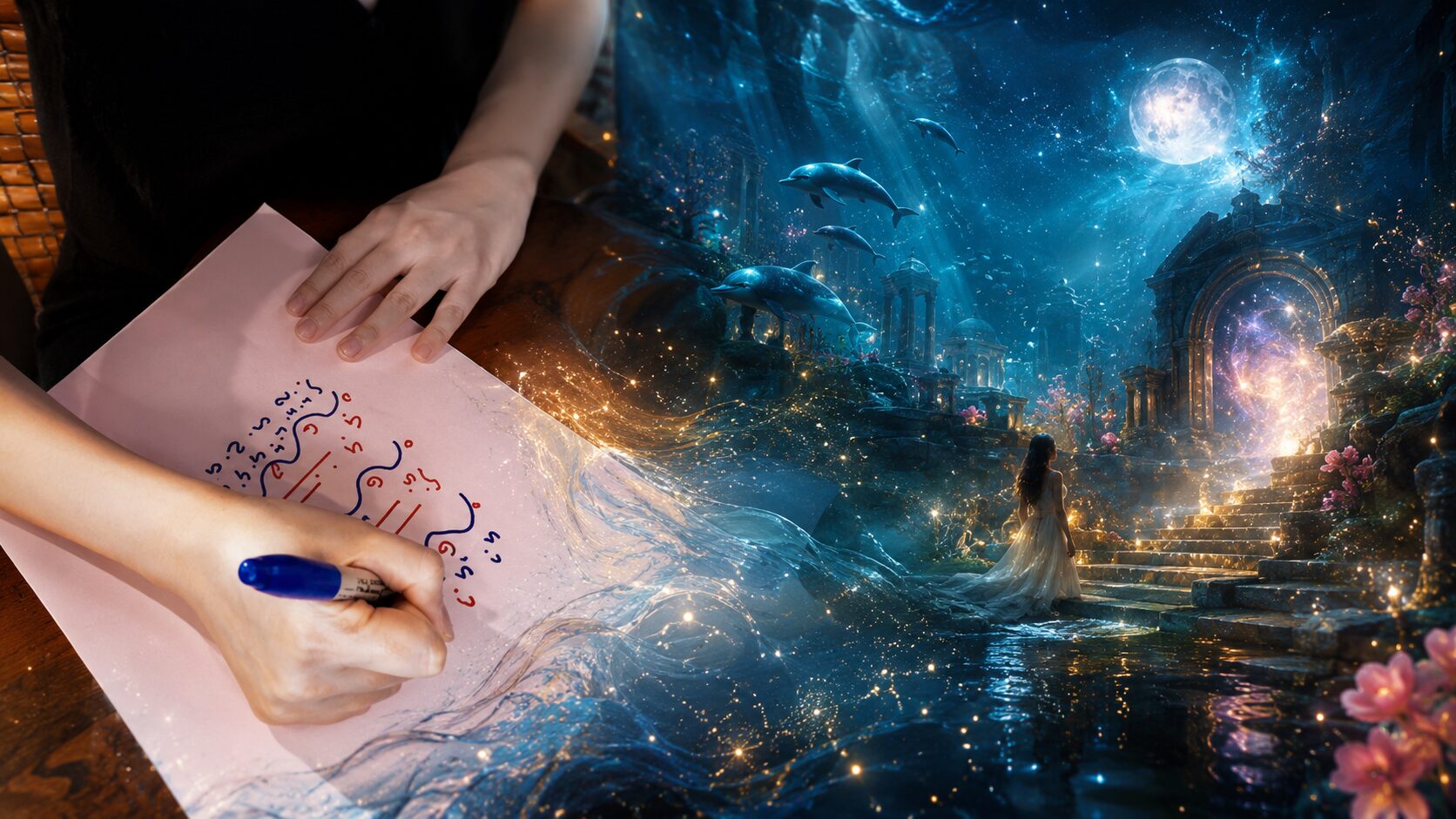
I am more excited to create by hand because I know that a finished artwork no longer has to be the end of its creative journey. Before I began experimenting with AI video, I could create a piece of Light Language art, photograph it, share it, and that might be the end of the story. It was complete, and there was nothing wrong with that.
Now I can look at the same piece and see five different worlds it could enter. It can move underwater. It can exist beneath a Lemurian moon. It can hang inside an ancient temple. It can become part of a cinematic journey. The same original artwork can open five completely different creative doorways without losing its own soul.
And strangely enough, that makes me want to draw more. The handmade artwork is no longer always the end of the creative process. Sometimes it is only the beginning.
AI Awakened the Director in Me
There is another part of my creativity that I didn’t even know was waiting to be explored : the director.
I don’t sit down with AI and simply ask it to make me a beautiful video.
I have a vision. I decide where the woman is standing, how she moves, where the camera goes, what happens to the light, what surrounds the artwork, what should remain still, what should be revealed and how I want the final moment to feel.
Suddenly I’m directing tiny five- or ten-second films. That has opened a completely different part of my creative mind. Ideas lead to more ideas. One experiment opens another possibility. A piece of art I thought I already understood reveals another doorway into its story.
In a strange way, AI hasn’t made me marvel at how creative AI can be nearly as much as it has made me realize how creative I am.
AI didn’t replace my creativity. It expanded my relationship with it.
Perhaps this is what gets lost when we reduce the conversation to human versus machine. We look at what AI can produce, but we don’t always ask what creating with it might awaken in the human.
But the Original Art Remains Mine
Coexistence doesn’t mean surrendering authorship.
There are places where I have very clear boundaries. When I use my original Light Language artwork in an AI video, I don’t want AI to redraw it. I don’t want it to reinterpret the symbols, improve the composition or add details that weren’t there. The artwork itself is non-negotiable.
This became what I call my preservation principle: the original artwork remains intact while the world around it is allowed to move. The environment can transform. The camera can move. Light can change. A human figure can interact with the world around it. But the art remains the art, because that piece came through my hands.
And that distinction extends far beyond visual art.
I Don’t Ask AI to Remember Lemuria for Me
AI is also part of my writing process, but I don’t ask AI to tell me what I remember about Lemuria. That wouldn’t make sense to me.
AI can help me organize something I’ve already written. It can help me notice where a transcript becomes repetitive. It can help me refine a sentence, structure an article or turn something I spoke about in a video into a more readable piece of writing. But the substance has to come from me: my experiences, my intuition, my memories, my spiritual understanding and my own relationship with what I am writing about.
AI can work with the words I give it. It cannot have my remembrance for me.
The same principle applies whether I am creating art, writing an article, teaching or working with someone spiritually. AI can participate in the process without becoming the source of the work.
What Remains Human
For me, this is where the conversation about replacement becomes much more interesting.
When I draw Light Language, I am not simply arranging symbols on a piece of paper. I am channeling frequency through my body and allowing it to move through my hands onto the page. AI might be able to create something that visually resembles Light Language, but resemblance isn’t what makes the art what it is.
The transmission is.
That transmission comes through a human being who has actually lived, loved, lost, changed, questioned, remembered and experienced the world through a body. It carries presence, intuition, relationship and lived experience because there is a person behind it.
This applies beyond art. AI might be able to respond beautifully to someone who needs guidance. It might help a writer shape their words or help a teacher communicate an idea. But participating in those processes is not the same thing as having the lived experience from which the work emerged.
Perhaps that is why I don’t feel that I need to choose between honoring what is human and being curious about what AI can do. I don’t need to diminish AI in order to honor the human, and I don’t need to diminish the human in order to explore AI.
There is room for both.
AI Is Part of Creative Abundance
Perhaps this is what I am discovering most deeply through all of this
We live in an abundant world.
If AI doesn’t belong in your creative practice, don’t use it. If you prefer art made entirely without AI, support those artists. If you love traditional mediums, keep creating with them. Their existence doesn’t threaten mine, and mine doesn’t have to threaten theirs.
Abundance also doesn’t require us to pretend technological change has no consequences. Some forms of creative work may change. Someone who once hired a designer for a simple logo might decide to generate one with AI instead. That possibility is real.
But I don’t believe that is where the story has to end.
Human creativity has never been static. We adapt, evolve, combine old mediums with new ones and discover forms of expression that didn’t exist before. As technology expands what is possible, perhaps it also invites us to expand what we believe is possible for our own creativity.
I don’t know exactly what that will look like. None of us do. But I don’t believe the edge of what we currently know is the edge of human creativity.
Scarcity sees a finite amount of creativity, opportunity and space and asks who will be left without it. Abundance reminds me that there may be possibilities we cannot see yet.
And perhaps AI itself is simply one of those possibilities.
The Artist Is Still Here
After all these experiments with AI, I still sit down with paper. I still pick up my pen. I still wait for the first line to come. I still create Light Language by hand because that is how intuition flows through me.
The artist hasn’t disappeared. If anything, she wants to create more.
And now, sometimes, when the drawing is finished, another part of me looks at it and wonders where we could go next. Underwater? Into a temple? Through a portal? Beneath the stars?
Someone suggested that AI might replace artists. When I look at what has actually happened in my own creative life, I see something very different. I see an artist drawing more, imagining more, experimenting more and discovering parts of her creativity she hadn’t met before.
So perhaps the question isn’t simply whether AI will replace artists. Perhaps the more abundant question is:
What becomes possible when the artist remains the artist?
That is the future I am interested in exploring.
If you are a sacred artist curious about exploring AI video without surrendering the integrity of your original artwork, I created The Sacred Art of AI Animation around the same preservation principle I use in my own work: keep the artwork intact while allowing the world around it to come alive.
LEAVE A COMMENT
Comments